The Trunk — What Holds When the Seams Have Closed

Cut into a big baobab and you do not find one tree. Radiocarbon dating of the largest African baobabs found that all of them are multi-stemmed: three to eight stems standing in a ring, grown together into what looks like a single column, and often not the same age as each other.
From the road it is one trunk. Up close, the bark runs unbroken across the joins. The tree closed over them centuries ago and left no line to read.
The column is a neighbourhood
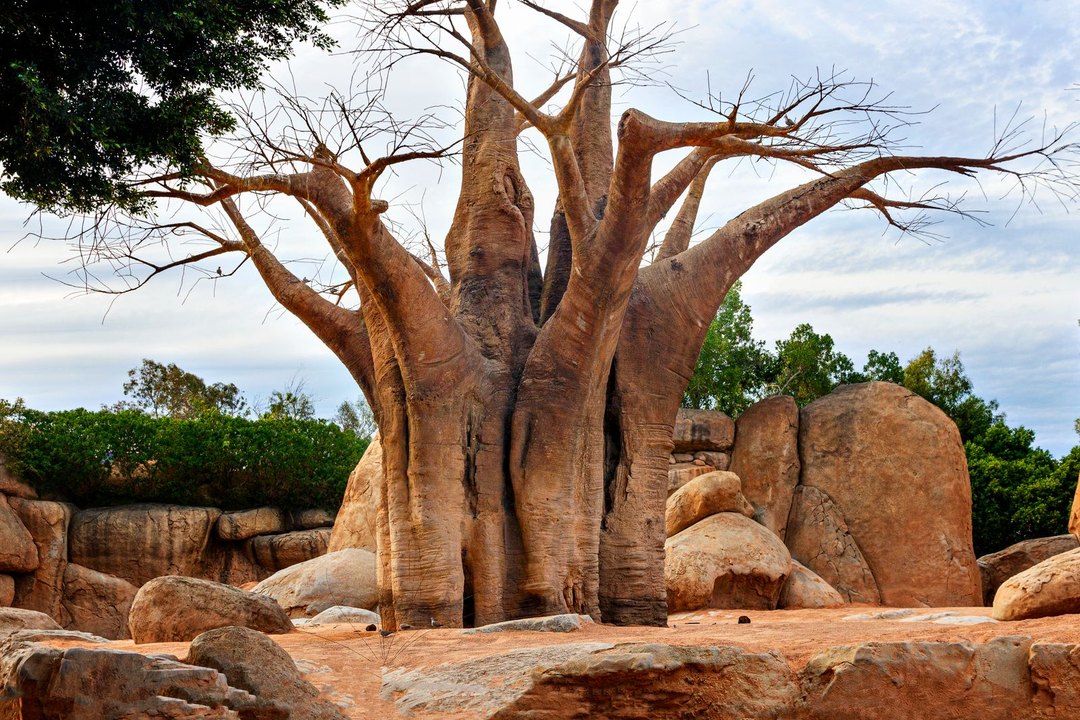
A young baobab starts as one stem. Then the root crown sends up another, and another, and over the centuries the newcomers thicken until they press against the old wood and fuse. In the most common form the stems stand almost upright and meet so completely that the outside runs smooth.
The oldest parts are on one side. The youngest grew up against them, and the joins between are the kind of thing a tree seals over and does not reopen. Ask where one stem ends and you arrive at a place where the question stopped mattering.
We describe people this way without meaning to. Someone we call solid is rarely one thing. It is the work that paid and the friend who stayed, a habit built in a decade nobody watched. None of it is visible from the road, and all of it carries the crown.
The space inside is not damage
Between the fused stems there is often an empty space running most of the height of the tree, closed to the outside, with a metre or more of living wood in its walls. Researchers call it a false cavity. It is not rot and it is not a wound. It is the gap the shape leaves.
We have written before about what the tree keeps inside, and it is worth separating two kinds of empty. One is what is left when something has been eaten away. The other is what remains when parts arrange themselves around a space on purpose.
The second kind is harder to trust. If you have stepped back from a job, or from a role in a family, and found that the room held its shape without you standing in it, you have met a false cavity. Nothing collapsed. The space was architecture.
Nobody saws a baobab into boards
The trunk is about seventy percent water. The wood is light and porous, closer to balsa than to oak, and when a baobab dies the trunk dries out and falls in on itself as a heap of fibre. It is no good for building and no good for burning. A nail can be driven into it without a hammer, and an axe either bounces off the spongy surface or sticks in it.
So the old trees were left standing while the land around them was cleared. They are still there because nobody could use them.
That is an uncomfortable kind of safety and we would not recommend it as a way to live. It says something about what we count as worth keeping. The parts of a life that get taken, spent, cut up and sold are usually the useful ones. What is left standing afterwards tends to be whatever had no buyer.
We are not sure that is a comfort. It is at least true of trees.
A practice for the week
Think of one person whose steadiness you stopped noticing, the way you stop seeing the trunk of a tree you walk past every day. Someone who became part of the column long enough ago that you cannot find the seam anymore.
Tell them plainly, with no occasion attached. Skip the thank you for the specific favour. Say the other thing: you are part of what holds me up.
It will be awkward. Say it anyway.
The baobab does not know how many stems it is. It stands, and the counting is our problem.
Who is holding up more of you than you have ever said out loud?
The Eye watches. The Tree stands. The Delve awaits.