The Fruit — What the Tree Makes to Be Taken

The baobab is careful with itself for most of the year. It drops its leaves, slows down, and holds what it has. Then, in the months it looks least alive, it hangs out its heaviest crop.
The fruit comes on bare branches. That timing is not decoration. It is the arrangement.
Nothing in it is for the tree
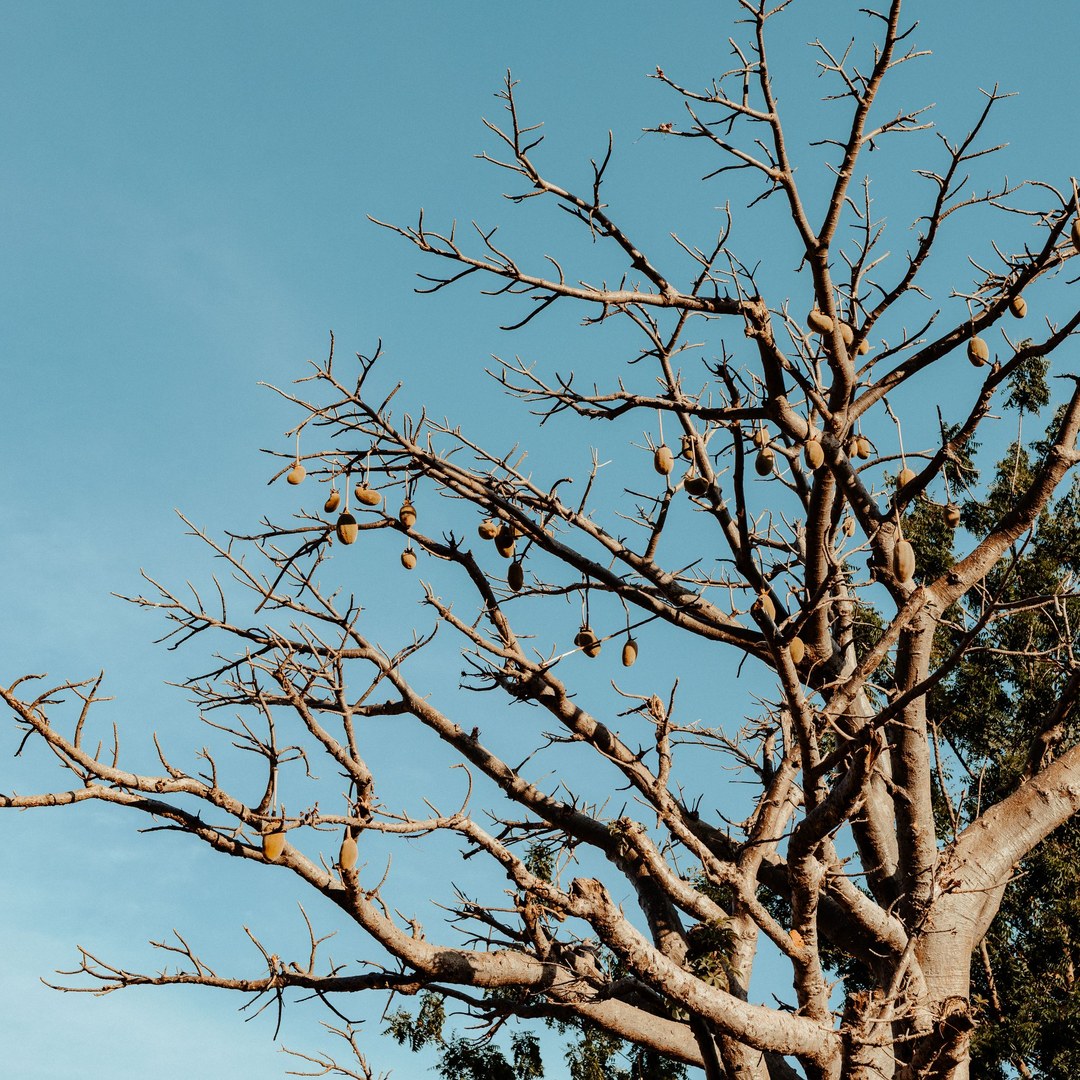
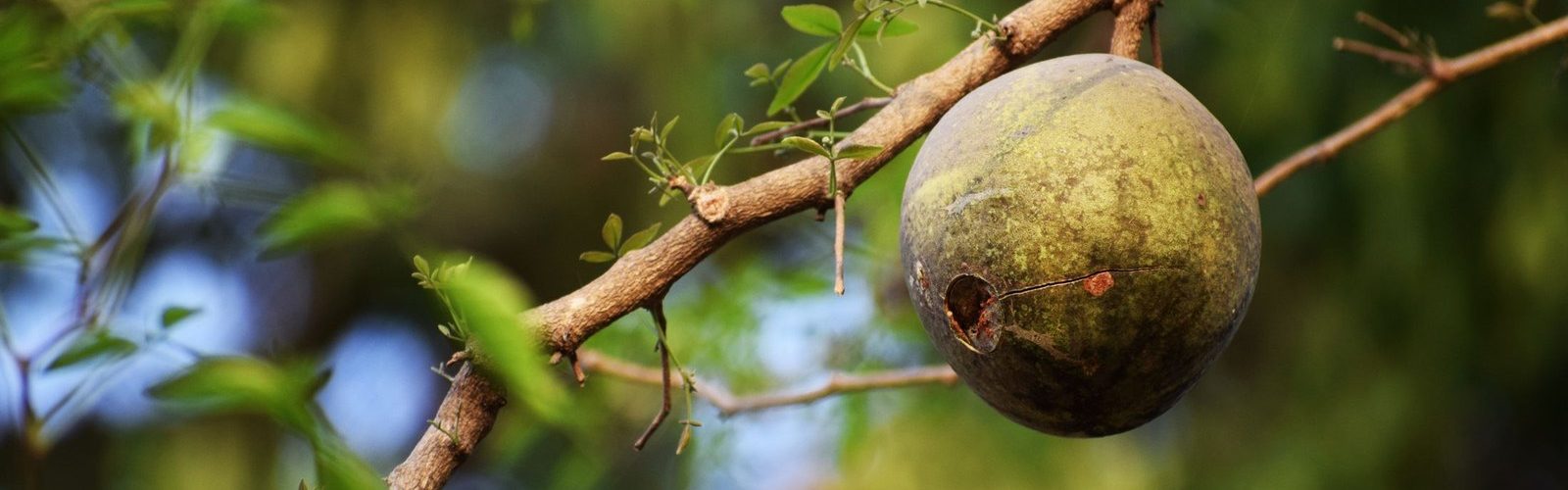
A pod is a hard oval, longer than a hand, wrapped in a green-brown felt that stiffens as it ages. Cut one open and nothing spills. The pulp inside has already dried.
The interesting part is the timing. The fruit dries while it is still attached. Sun and moving air do the work, the shell holds the result, and by the time the pod lets go the contents are powder. Nothing needs pickling, curing, or rushing to a market. It keeps, in its own container, on its own clock.
Everything the tree spent on that pod went into something the tree will never eat. The water it carried through the dry months, the sugars built by leaves that are already on the ground: all of it stored in a package facing outward. The fruit does not feed the tree that made it. It exists to leave.
Built to be handled
Inside the shell sit the seeds, packed in pale powder that tastes sharply sour. The sourness is tartaric acid, and it is part of why the powder keeps. The pulp is also very high in vitamin C, high enough that it is sold as a supplement in countries where the tree does not grow.
We have written before about what the tree was before it was a tree. The seed has one problem. A seed that lands in the shade of its parent gets a hard start, and a shell that thick does not open by itself. So the fruit pays for transport. Baboons and monkeys tear the pods open where they hang, which is where the name monkey bread comes from. People gather the fallen ones off the ground and carry them home. Either way the seed travels, and often it travels through something’s gut, which is a rough way to be scarified and an effective one.
A thing that will be carried by someone else has to be built for it. Hard shell. Dry contents. Nothing that spoils if the journey takes a season. The tree did not make something fragile and then hope for careful handling.
The awkward half of giving
We make things more easily than we release them. The Fruit-Givers take their name from this tree, and the making was never the difficult half.
Watch what the tree does not do. It does not check who takes the fruit, or ask whether the pod was used well. Some pods rot where they fall. Some are opened by an animal that will scatter the seeds badly. The tree is not keeping score per fruit.
There is a version of generosity that is really supervision. You hand something over and then stand close enough to watch how it is treated, ready to be hurt by the answer. That is not a gift. It is a loan with feelings attached.
A practice for the week
Take one thing you made and put it where it can be picked up. Not described to someone, not offered with instructions attached, not held out at arm’s length waiting for a reaction. Sent. Left. Handed over, and then walked away from.
Expect the discomfort to arrive within a day. It is not evidence that you did it wrong. It is the shell doing its job.
The pods hang through the bare months, they fall, and the tree stands there with less than it had when they were hanging. Somewhere else, later, a tree.
What are you still holding on the branch?
The Eye watches. The Tree stands. The Delve awaits.